
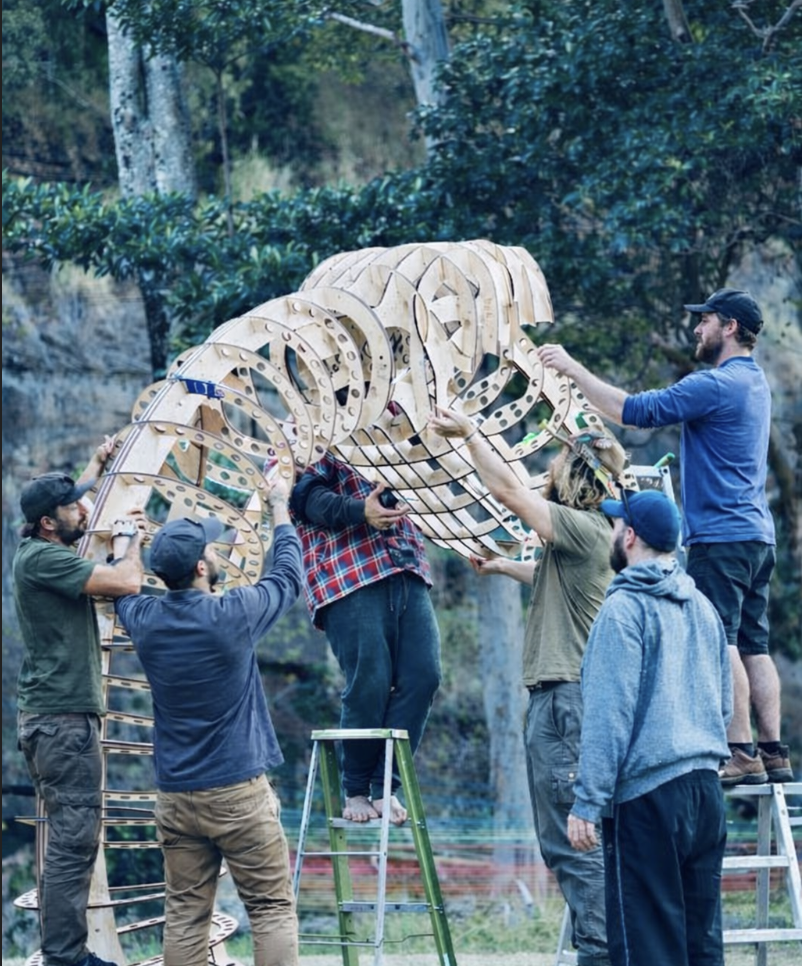
Why Collective Making
Many contemporary work environments rely primarily on abstract coordination—planning, discussion, and digital communication—rather than shared physical tasks.
This work introduces a collective, hands-on process that requires cooperation, sequencing, and mutual reliance. Participants engage in a shared task where progress depends on coordination rather than individual control.
The process is structured as an artwork, not a training exercise.
Its purpose is not optimisation or instruction, but the creation of a shared form through collective action. The result is not a discussion or a simulation. It is a large-scale artwork that stands because people worked together to build it.
Collective effort becomes materially visible. The outcome belongs to the group.
How It Works
-
Each installation is developed as a modular system that can be assembled manually without specialised skills or machinery.
Research on collaborative creativity shows that shared, manipulable structures support group problem-solving and coordination more effectively than abstract planning alone. Modular systems reduce cognitive load and allow participants to focus on interaction, sequencing, and joint action rather than individual expertise.
What this enables:
Accessibility across roles and skill levels
Immediate engagement through physical action
A shared task space that supports coordination
-
No single participant controls completion. The structure can only be completed through coordinated action.
Studies on cooperative learning and collective creativity demonstrate that positive interdependence—where success depends on mutual reliance—strengthens group cohesion, accountability, and shared ownership. Groups perform more effectively when authority is distributed and outcomes are co-produced rather than directed.
What this enables:
Flattened hierarchies during the build
Shared responsibility for progress
Psychological safety through non-competitive participation
-
Progress depends on coordination, timing, and shared responsibility.
The finished structure records the process that produced it.
The process is the content.Why this matters:
Peer-reviewed research on participatory arts and group creative processes shows that visible shared outcomes reinforce social cohesion, trust, and collective identity. When effort becomes materially visible, groups retain a stronger sense of contribution and meaning beyond the activity itself.What this enables:
A tangible record of collaboration
Reinforcement of shared effort and coordination
Outcomes that belong to the group, not the facilitator
Ways to Work Together
Each engagement is structured to match how much involvement, support, and customisation your organisation requires. All options result in a serious, long-term artwork—the difference lies in process ownership, risk profile, and cultural depth.

License an Art Installation
Best for Organisations seeking a clear, distinct artwork with minimal complexity
What you receive A flat-packed, fabricated installation with assembly documentation
Level of involvement Internal assembly, independent delivery
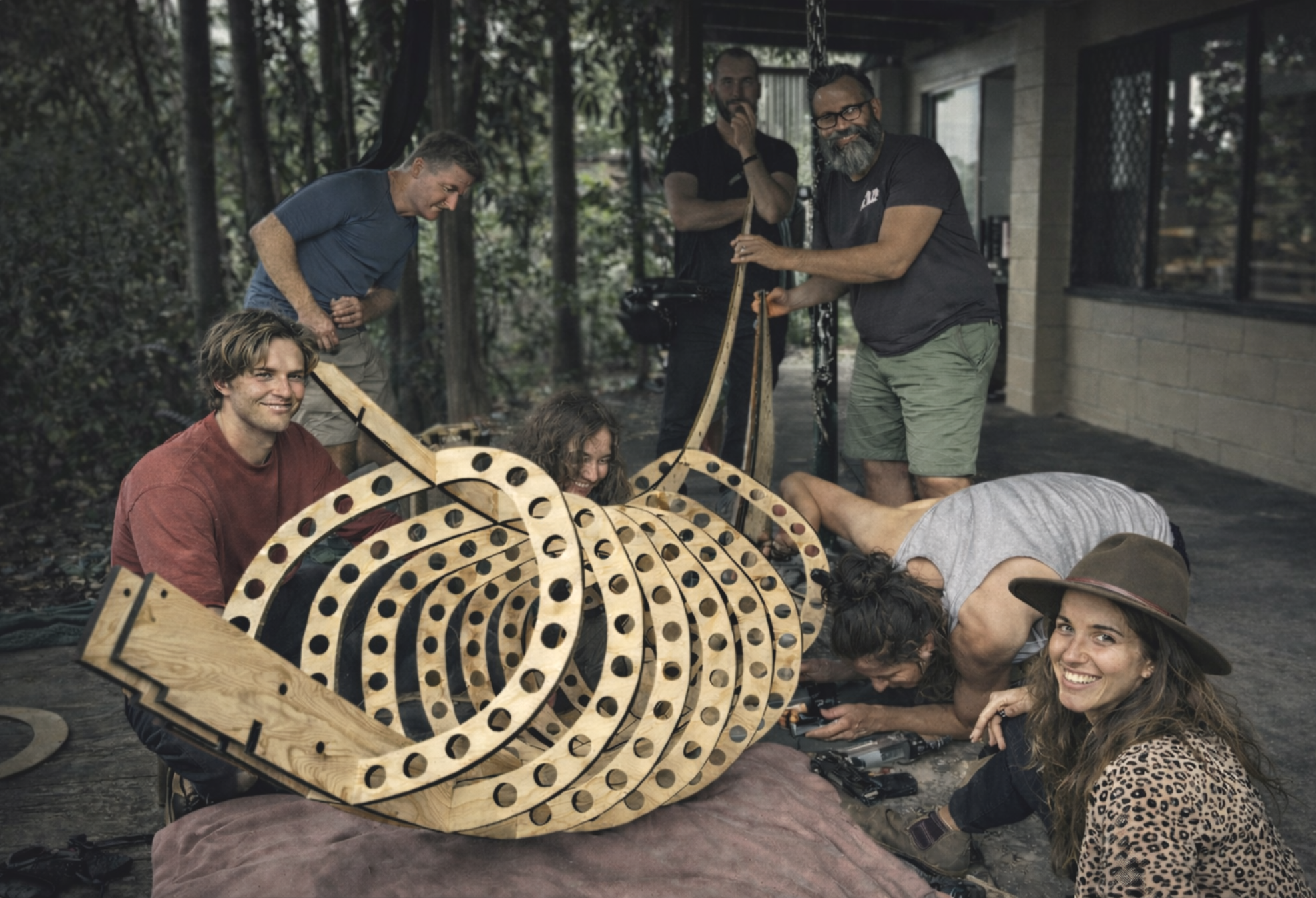
On-Site Assembly Support
Best for First-time builds, complex sites, or high-visibility installs
What you receive Physical installation + facilitator presence for guidance
Level of involvement Internal teams with on-site support

Commissioned Artwork
Best for Cultural activation, headquarters lobbies, values-led environments
What you receive A bespoke artwork co-developed with the organisation
Level of involvement Conceptual participation + light hand-work
“Their attention to detail and commitment" to quality truly stood out. We’ve already recommended them to others.”
Robbi Ouzonoff (We Rise, Women’s gathering)